Australia is a continent of environmental extremes. From the scorching heatwaves of the Outback and Northern Territory to the freezing winter winds of the Victorian Alps, the Australian climate poses unique challenges for building design. At the heart of creating comfortable, energy-efficient and resilient structures is the humble roof cavity. Operating as a qualified insulation contractor in Australia requires far more than simply rolling out fibreglass batts in an attic space. It demands an in-depth understanding of building physics, strict adherence to national construction codes, rigorous health and safety protocols and a keen awareness of local climate zones.
Navigating Australia’s Climate Zones & Building Regulations
One of the defining aspects of working across the Australian building sector is the sheer variety of microclimates. The National Construction Code (NCC) divides Australia into eight distinct climate zones, ranging from hot humid summer conditions in Tropical Queensland to cold alpine regions in Tasmania. A successful insulation contractor must tailor every solution to the specific demands of the local site.
In recent years, the Australian building landscape has undergone a major shift with updates to the NCC, which raised the minimum energy performance threshold for new residential homes to a 7-Star NatHERS rating. This regulatory change has elevated roofing insulation from a secondary consideration to a critical structural priority. Achieving high thermal resistance (R-values) requires an intricate combination of bulk insulation, such as glasswool, earthwool or polyester, paired with reflective foil sarking and vapour-permeable membranes.
Furthermore, vast swathes of suburban and regional Australia fall within designated Bushfire Attack Level (BAL) zones. In these areas, Australian Standard AS 3959 dictates stringent building requirements to guard against ember attack and radiant heat. Roofing insulation materials must comply with AS 1530.1 non-combustibility testing, ensuring that sarking and roof blankets do not ignite under sustained ember showers.
Technical Precision: Managing Thermal Bridging & Moisture
Installing roof insulation is a craft where details matter immensely. A gap of just 5% in ceiling insulation coverage can reduce the overall thermal efficiency of the entire system by up to 50%. Australian tradespeople must be meticulously trained to avoid compressions, unsealed joins and thermal bridging — where metal roof battens or steel rafters act as direct conductors of outside heat.
Another critical aspect of the trade in Australia is condensation control. In cold climates during winter or warm humid coastal areas during summer, moisture vapour inside the home rises towards the cooler metal or tile roof. If this vapour hits a cold surface without adequate ventilation or vapour barriers, it condenses into liquid water. Over time, unmanaged moisture causes timber framing rot, steel corrosion, ceiling sagging and toxic mould growth. Today, an experienced insulation contractor acts as a building envelope specialist, selecting the correct vapour-permeable sarking and calculating dew points to guarantee long-term indoor air quality and structural integrity.
On-Site Safety: Surviving the Heat & Attic Space Hazards
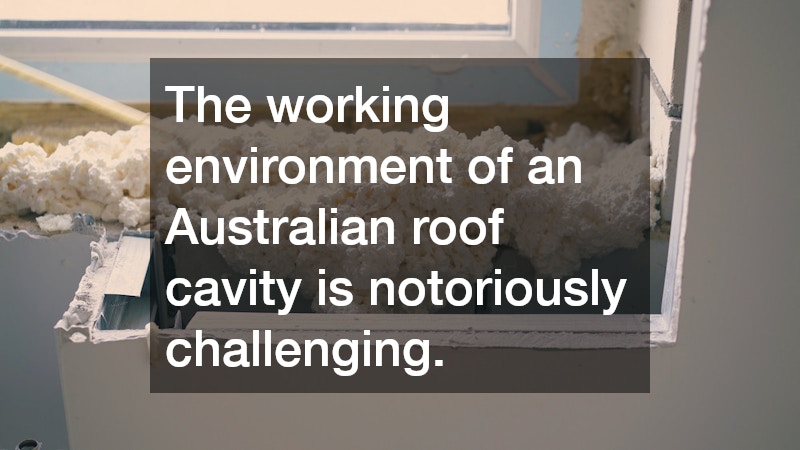
The working environment of an Australian roof cavity is notoriously challenging. During peak Australian summers, ambient temperatures inside a roof space can easily exceed 60°C. Working in these conditions requires strict heat stress management, frequent rest breaks, proper hydration and careful scheduling to complete installations during early morning hours.
Beyond thermal stress, safety protocols are paramount. Tradespeople routinely navigate cramped roof spaces filled with dust, sharp timber framing, overhead hazards and live electrical wiring. Safety training covers:
- Electrical isolation: Turning off main power switches before entering roof spaces to prevent accidental electrocution from damaged or outdated wiring.
- Personal protective equipment (PPE): Wearing respiratory protection, safety eyewear, gloves and protective coveralls to shield skin and lungs from synthetic mineral fibres and airborne dust particles.
- Fall protection: Implementing edge protection, harness systems and roof safety mesh when working on pitched metal or tiled roofs prior to ceiling lining installation.
Business Growth & the Future of the Trade in Australia
The commercial landscape for Australian thermal specialists is expanding rapidly. Rising electricity costs and extreme weather events have driven homeowners, body corporates and commercial developers to seek retrofit options for older buildings. Millions of existing Australian dwellings were constructed prior to mandatory insulation standards and feature uninsulated roof cavities that bleed energy.
For any trade business, establishing a reputation as a trusted insulation contractor relies on precision, clear client communication and staying updated with evolving building standards. Offering end-to-end services—including roof space audits, acoustic attenuation for urban noise control, bushfire-compliant retrofits and thermal imaging assessments—allows contractors to differentiate themselves in a competitive market.
Ultimately, working as a roofing insulation specialist in Australia is a challenging yet highly rewarding trade. By combining practical craftsmanship with a deep technical knowledge of thermodynamics, bushfire compliance and moisture control, contractors play a vital role in building cooler, safer and more sustainable Australian communities.